Please share pics of your homemade dulcimer bags and cases
General mountain dulcimer or music discussions
Wow! What an assortment of bags, fabrics, colors and prices! Who'd a thunk it? I never even heard of a yoga mat bag until I read Marg's post!
Wow! What an assortment of bags, fabrics, colors and prices! Who'd a thunk it? I never even heard of a yoga mat bag until I read Marg's post!
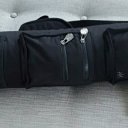
I wish I could say, I had made mine but I didn't. I thought of just getting a table runner and folding over and sewing up the sides. My (new for me dulcimer) is a slander rectangle, so would move around too much in a standard dulcimer bag or case. I went looking for something, maybe a heavy duty laundry bag but ended up with something I had not even thought of, so funny - 'A yoga mat bag'
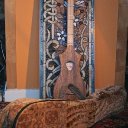
I made this bag for the Seagull Merlin, this was the instrument that introduced me to the Mountain dulcimer. It is now a wall hanging.
OH ANNIE!!! ~that is beautiful treasure~
Thanks, Ken and Jennifer, I passed that on to the maker. I thought I'd be in search of a hard case, until I read Irene's post!
Annie, that's very pretty. What a nice dulcimer bag!
Ken
"The dulcimer sings a sweet song."
Maggie said, "Jim, you're not going to take a picture of that thing before you wipe the dust off."
Sorry Maggie.
Sorry, there they are now...looks like I can't spell today, either!😉
Ok, so that didn't work I guess....or can others ee them? A.
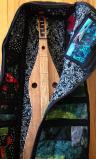
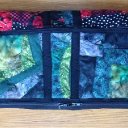
Will try to post some pics of the dulcimer bag Melody made for me. I love to kayak, so the top is green for the pines on shore; the bottom is blue for the water. Lining covered with musical notes. 2 little pockets for noter and picks. She had bought the batik fabrics a few years ago...prettiest gift ever. Crazy quilt style, she says. To luck me, it's a work of art.
I'm new as well, have just bought my first MD after thinking about it for ages, having tinkered with a Strumstick type device. At the moment still at the "Go and tell Aunt Nancy" (what you folks across the water call "Go tell Aunt Rhody" ... we have an extra half-beat on you there ....)
It's a small world, I'm from Norfolk, England as well. I'm semi retired now ; I used to teach children with Special Needs (of varying types .....) and I now write Computer Software occasionally, contract work.
I'm currently working on a (free definitely open source probably) visual TAB player for Dulcimers to help me learn, basically you feed TAB and/or Chords into it plus some timing data and it plays it back at you showing the TAB, you can change the speed etc. If you've ever used Yousician, a bit like that, except there's no audio detection of what you're playing.
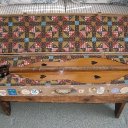
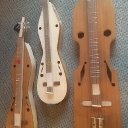
Here are two photos of the case I built for the first dulcimer I made.
Ken
"The dulcimer sings a sweet song."
Sooo... I haven't finished! I never lined it and must get to work before my new (dulcimer) baby arrives!!!!!
Thank you, Matt. Those cross braces seem to me to be more a construction aid, helping to keep the shape, than a source of strength.
Is anyone from FOTMD planning on going to the Tennessee Fall Homecoming at the museum of Appalachia this year???
BlackDog, seems the foot stomper would be easy to come up with on your own, it is a good idea. Lisa I do like the tambo on the shoe thing too. 
John, yea, most braces on mountain dulcimers are like bicycles for fish. If you can safely take them out through the sound holes it is probably a good idea. If the brace needs to stay, I usually drill a small hole in the back and glue in a dowel plug when done. The guys at Folkcraft have done some cool work with laser cutting figures to glue in the holes after fixing, but that requires a good laser cutter.
If you are working on a baritone or bass dulcimer, carefully consider before removing the brace. The larger sound board may need them. Also consider the choice carefully if the soundboard is spruce, cedar or other softwood. Those board may need the extra support.
PS. I am not your standard dulcimer maker and will probably put some people's backs up with my comment on bracing. Conversely, I brace all of my instruments as I do not attach the fretboard to the soundboard. To each their own.
We also have a dedicated Group here on FOTMD where UK members can stay updated on local events and make new friend and local jamming connections! : http://fotmd.com/john-henry/group/41/uk-and-european-mountain-dulcimers 


Hi. Since I acquire used instruments I often have repairs which need to be taken care of. A particular problem for me is the issue of loose braces. I'm curious how people go about reparing them. On a flat-top guitar I can usually work through the soundhole. But dulcimers are too shallow and the soundholes are too small to do this easily. I'd like to hear how people address this problem. Do you take the backs off, the way a violin repairperson might? Or do you work from the outside, with small holes, glue-and-screw, to be replaced with small dowels? Or do you simply take the offending brace out? They really don't do much and I see Warren May and other makers don't use them.
Please teach me. Thanks. 
Alison -- being on that side of The Pond, you'll want to get to know Robin Clark, who is a member here. He lives up in Snowdonia, Wales, and has a company called Bird Rock Dulcimers. Robin is extremely knowledgeable about dulcimers as well as guitars. He is importing dulcimers made here, some built specifically to his design. His website is
http://www.dulcimers.co.uk or you can call him on +44 (0)1654 712671
Anyone familiar with builder/player Russell "Russ" Green. He worked in Detroit, apparently built dulcimers in his basement, and continued to build after he retired to Hartselle Alabama. He passed away in 2000. I'm from Alabama and am interested in makers from the state, but had never heard of Mr. Green until I came into possession of two of his instruments earlier today. They are simple but quite well-crafted dulcimers: internal bracing, full kerfing, good intonation, clean seams and joints, etc. They have skinny fretboards for 4-stringers (around 1.25"), but they still play nicely and have good tone with OLD strings. Can't wait to clean them up and see what they can do. Does anyone else here have a Russ Green dulcimer, or did anyone know him? If he is a largely unknown maker, it is truly a shame.
Lisa, You may have invented a new shoe style.  But seriously, this is a neat idea. I wish I had saved all the little percussion "toys" from when my boys were little...
I really want to learn how to beat out rhythm on my dulcimer while playing....
This is more expensive but leave it to the cigar box guitarists to come up with something interesting! On the C.B. Gitty site there is info and a You Tube video of their spokesman stomping it out. https://www.cbgitty.com/cigar-box-guitars/shane-speal-foot-stomper-active-foot-percussion-instrument-standard-model-1/
If nothing else, it may serve as inspiration. Barb
I wish.. I wish... I wish....
That is just "too cute"!!! Love it!
Cindy, if you don't look like the head of a dulcimer, I won't recognize you....
Hi Jan! It was great meeting you at Dulcimer U.
Unicoi is up in the air for me as my limited Dulcimer budget has been pretty much ransacked between Dulcimer U and Black Mountain.
BUT, I reserve the right to blow the budget every now and then, and may just wind up in Unicoi.
I will definitely see you around.
One of our members here on FOTMD has some fun ways to provide percussion. Check him out you may get a lots of ideas and he and his pal are really enjoyable to watch. Enjoy!
I really like the idea of stringing bells to your shoes.
I use two different foot rhythm devices- both are 'low tech' though:
I made an ankle percussion strap that closes with Velcro. I sewed various rattling/jangling things on it. When I tap my foot with my heel, it works well but obviously does not sound like a drum, more like rattles. But when combined with the stomp of a hard heel on my shoe, it works nicely. This doesn't work as well if you are a toe-tapper rather than a heel tapper.
Same thing with putting a tambourine under my foot- I put the tambo on the floor with the skin side down. Then I put my toe into it and that lets my heel rest on the rim edge that's nearest me. I then tap my heel down on the tambo rim and that creates the rhythm. There's a percussive quality if you use your heel assertively.
Paula, I have not used any of these devices. You can do a search for drum machines which are devices that create drum sounds/rhythms and are connected to amplifiers. Usually they come in the form of pedals. Looking at stores like Elderly Instruments or Sweetwater, you can find many options. Another way of doing it, I think, is by using an iPad/tablet or computer or phone, with some app on it that produces rhythms. I think the latest Dulcimer Geek podcast at DPN talks about pedals for use with dulcimers. Check it out at the Dulcimer Players News website. Sequencers and samplers may also produce rhythms for accompaniment.
Ken
"The dulcimer sings a sweet song."
They are generically called Rhythm Boxes, and run from $60 up. Some have an optional foot pedal. Korg (the same folk who make electronic tuning devices) makes several versions.
A lot of professional musicians have something that provides rhythm... drums sounds etc. They use Some sorts of pedals and whatever... Can anyone enlighten me on what you need to provide rhythm? Are they using a keyboard that is programmed to provide rhythm? but I do see them using a pedal... I am totally lost on this one!
what do they use?
Dulcinina -- string tuning "trick" to avoid breaking strings when tuning them: Never tune a string that isn't humming. Decide which tuner controls the string you want to tune. Pluck the string, and while it's vibrating give the tuner a quick quarter turn. If you do not hear the string change tone, STOP -- you are not turning the right tuner. Find the right tuning knob and try again. If the string does change tone, pluck it again and tune it to the note you want.
Nina, you can trim the strings without cutting them by bending them back and forth and back and forth and back and forth until they break on their own, which will almost always be right at the point where they emerge from the hole in the post. That way nothing will be sticking out. I usually don't bother with that and just snip them with wire cutters, but then I use the side of the wire cutters to bend the sharp end in so that they don't stick out straight.
Another option, though it looks kind of funky, is not to trim the ends at all, but when you are dong to run them along the side of a pair of scissors. The string will curl up into a bouncy coil. That is the same technique you've probably used with ribbon when wrapping presents.
In the future, I hope we all have those self-trimming tuners that Brian G mentions above.
Hi Everyone, I changed my bass string using the bass string from my old dulcimer. We have one music store and the guy was as helpful as he could be but had never even seen a dulcimer before. And I live in south central KY! He pulled out some strings and we eyeballed it. They don't carry individual strings anymore, and I had to buy a pack. I put on the string and promptly broke it. So I took off the bass string from my other dulcimer and I have no idea the gauge. But it plays much better. Now I have a couple sets of melody and middle strings. They'll eventually get used.
I also trim the string before winding. I couldn't get as close to the end as I wanted for the final trim and there's a sharp end sticking out. Wished I had read the hint about leaving enough string to make a little kink at the end. This dulcimer has different tuning pegs than I'm used to. The middle and melody strings have nothing sharp sticking out and I can't imagine how they trimmed the strings so close. I was glad to read all the responses.
Nina
Brian, Interesting, and good recommendation. If I can ever find plans for a guitar head dulcimer, I'll give these a try.